
What KYC Central Is Building: UK Company Due Diligence
KYC Central is a UK company due diligence platform, not yet open. What one assessment will check, who it is for, and what it deliberately will not do.
The KYC Central Team ·
KYC Central is a UK company due diligence platform that will speed up your KYC/AML workflow, without taking over. It's not quite ready for release yet, but in the mean time, I wanted to take a moment to explain a few things to get you all excited!
Who we are building it for
If your firm is supervised under the Money Laundering Regulations 2017, whether as an accountancy practice, a law firm, an estate or letting agent, or a trust or company service provider, you have to carry out customer due diligence before you take on a business client. You also have to be able to show your working afterwards. The same checks come up when a lender onboards a borrower or a business vets a new supplier. The industry often calls this KYB, know your business: the company-level counterpart to verifying an individual's identity.
Plenty of the people doing this work do not have a screening team behind them. They are a partner, a practice manager or a compliance officer fitting the checks in around everything else. KYC Central is for that person: someone who needs a thorough, repeatable check on a UK company, and a record of exactly what was checked and when.
What one assessment checks
An assessment starts from the company number and works outwards, from the company to the people who run it, the people who own it, and the lenders who hold security over it.
The company itself
From Companies House: the company profile and status, its nature of business, its filing history, and whether its accounts or confirmation statement are overdue. Outstanding charges, and who holds them. Any insolvency proceedings on the company's record. Shareholders are taken from the share register filed with the confirmation statement, so that they can be compared with the register of persons with significant control. The two registers do not always tell the same story, and when they disagree, that disagreement is itself worth reading.
The people around it
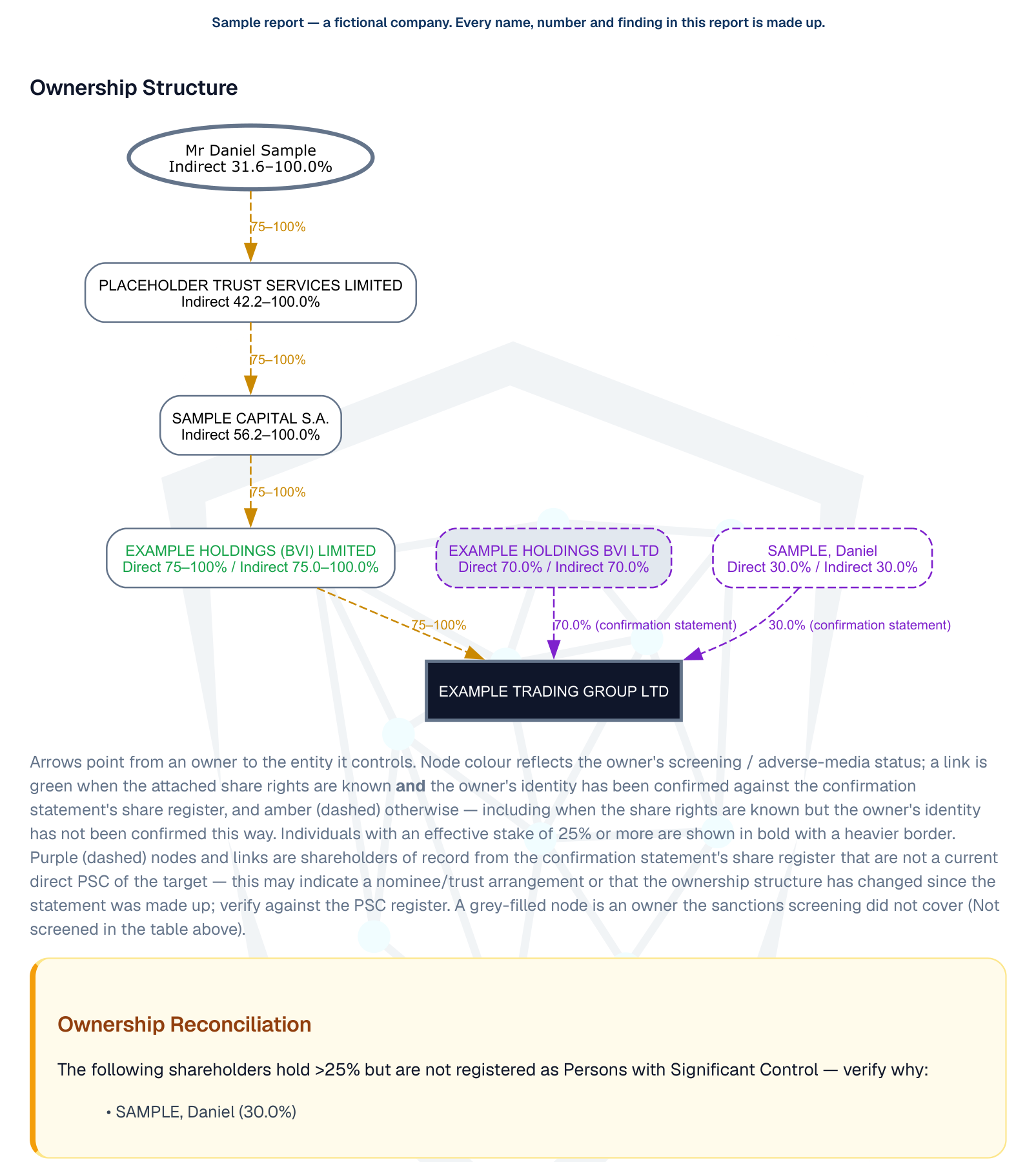
Every active officer and every person with significant control is identified, and each director is checked for a current disqualification under the Company Directors Disqualification Act 1986. Acting as a director while disqualified is a criminal offence, so this is flagged as critical. Where a person with significant control is itself a company, the assessment follows the chain upwards and works out direct and indirect ownership percentages, so a structure several layers deep resolves into something you can read.
Sanctions
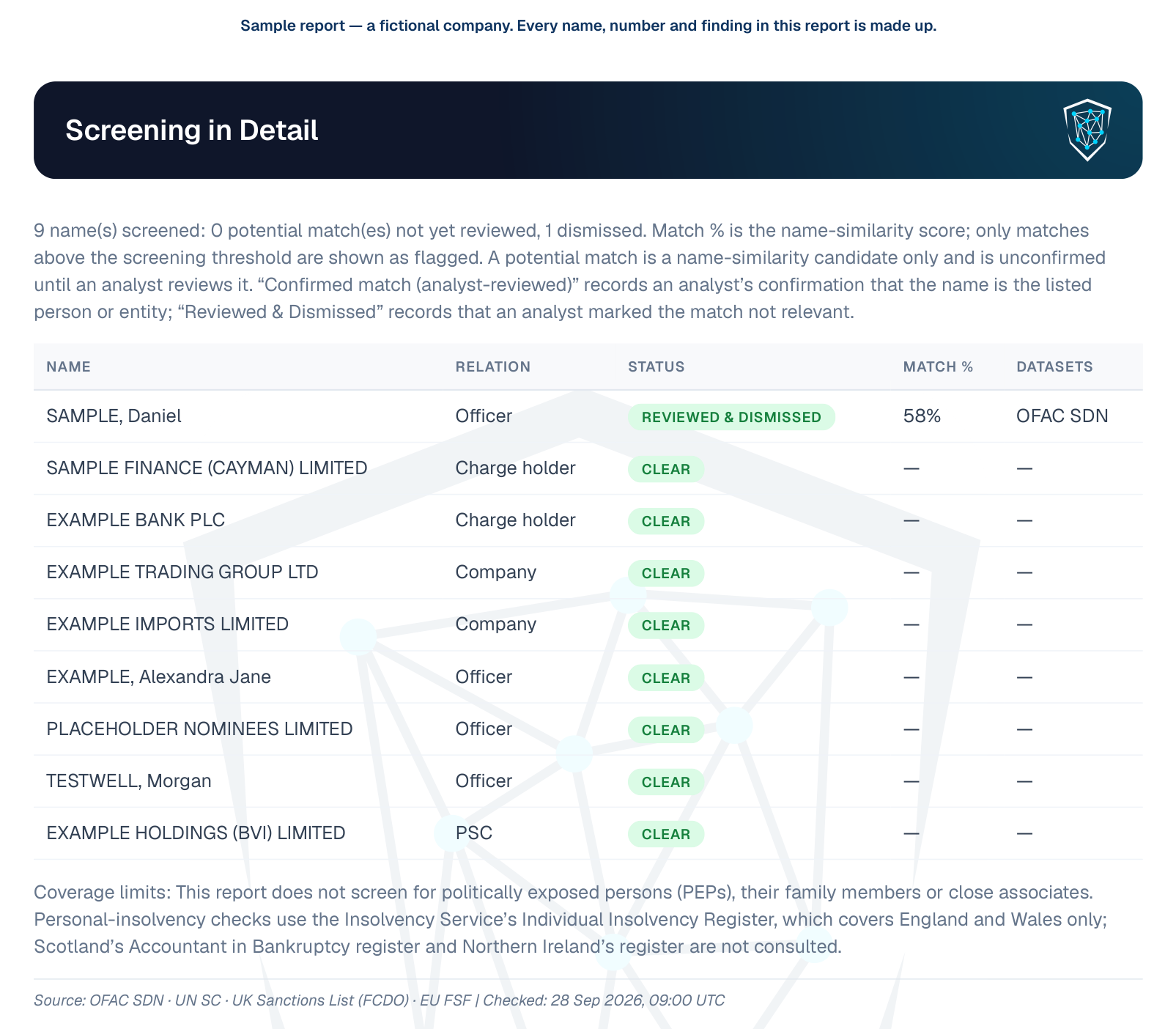
The company, its active officers, its persons with significant control and the holders of its outstanding charges are screened against four sanctions lists: the OFAC SDN list, the UN Security Council Consolidated List, the UK Sanctions List and the EU Financial Sanctions Files. Charge holders are on that list deliberately. A sanctioned secured creditor is a real signal, and it is one that is easy to miss when you are checking by hand.
Matching tolerates spelling and transliteration variants, because the same name can be romanised several ways. That cuts both ways: a close name match still needs a person to compare it with the designation, and each match can be reviewed and dismissed, with that decision carried into the report.
Sector authorisation
A company that claims to do regulated work should appear on the right register. One pass covers the FCA Financial Services Register, the Charity Commission register, the Gambling Commission's licence register, CQC registration, HMRC's register of businesses it supervises for anti-money laundering, HMRC VAT registration, and the Solicitors Regulation Authority's register of firms. You choose which registers are relevant to the company in front of you, and a register you mark as not applicable says so in the report rather than silently disappearing.
Ownership across borders and offshore exposure
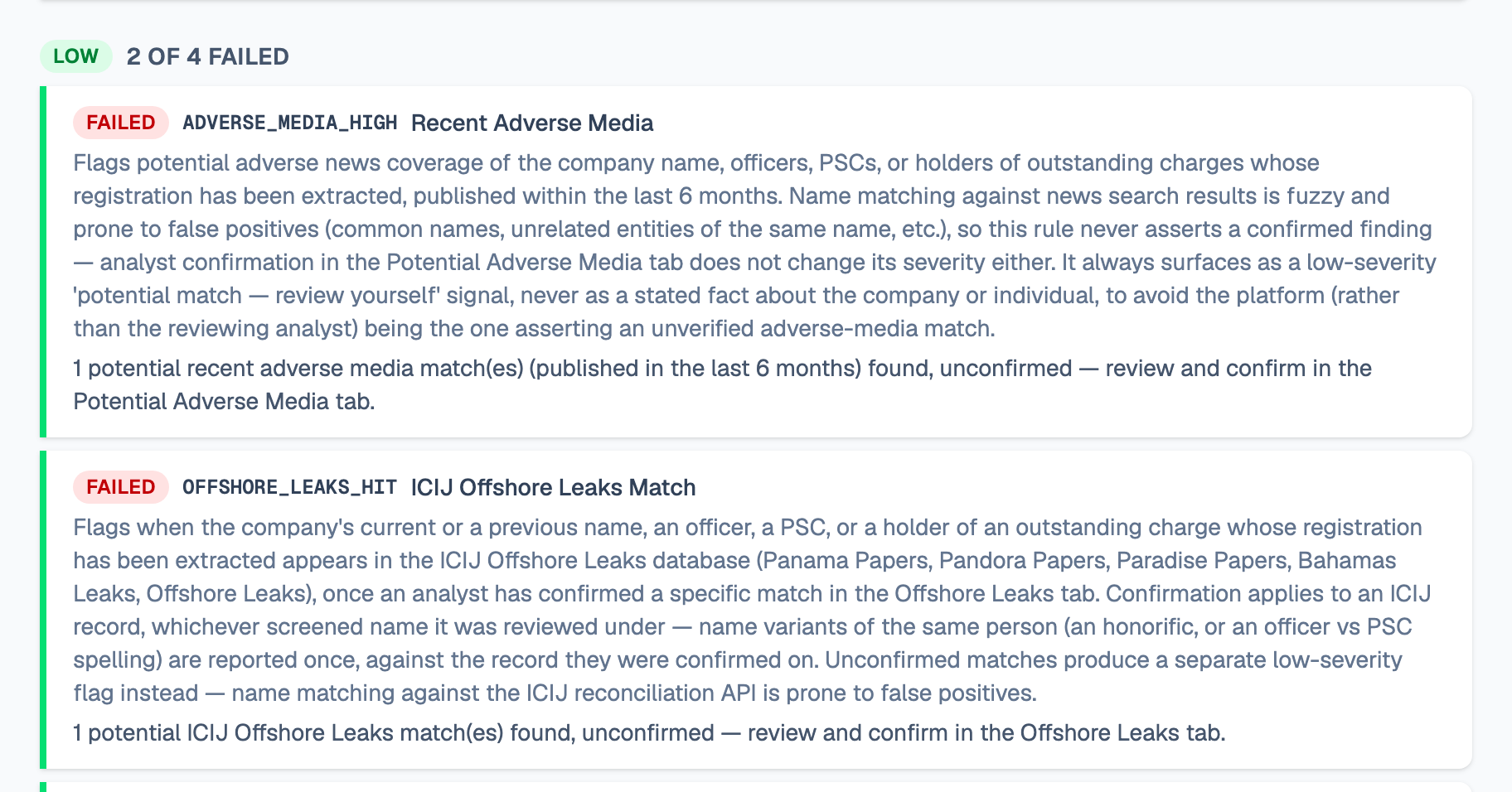
Where the company has a Legal Entity Identifier, GLEIF gives its registration status and its corporate parent chain, and any parent registered in a FATF high-risk jurisdiction is flagged. The company and the people around it are also checked against the ICIJ Offshore Leaks database. Those name matches are held as unconfirmed until an analyst has looked at the specific record, because a common name will find all sorts of unrelated people, and a coincidence presented as a finding is a false statement about a real person.
Potential adverse media
The company and the people around it are also searched for in news coverage. Each result shows the headline, the publication, the date and the search snippet, and links to the original article. An article counts as a potential match only if the name being screened appears in its headline or snippet. A company with "Nominees" in its name should not pick up a story about a government nominee. Even then, a name in an article is not proof that the article is about your subject. So a news match raises a low-severity flag, and it stays low-severity even after an analyst confirms it. The article goes into the file as evidence for a person to weigh; the software does not turn it into a verdict.
How the findings come back
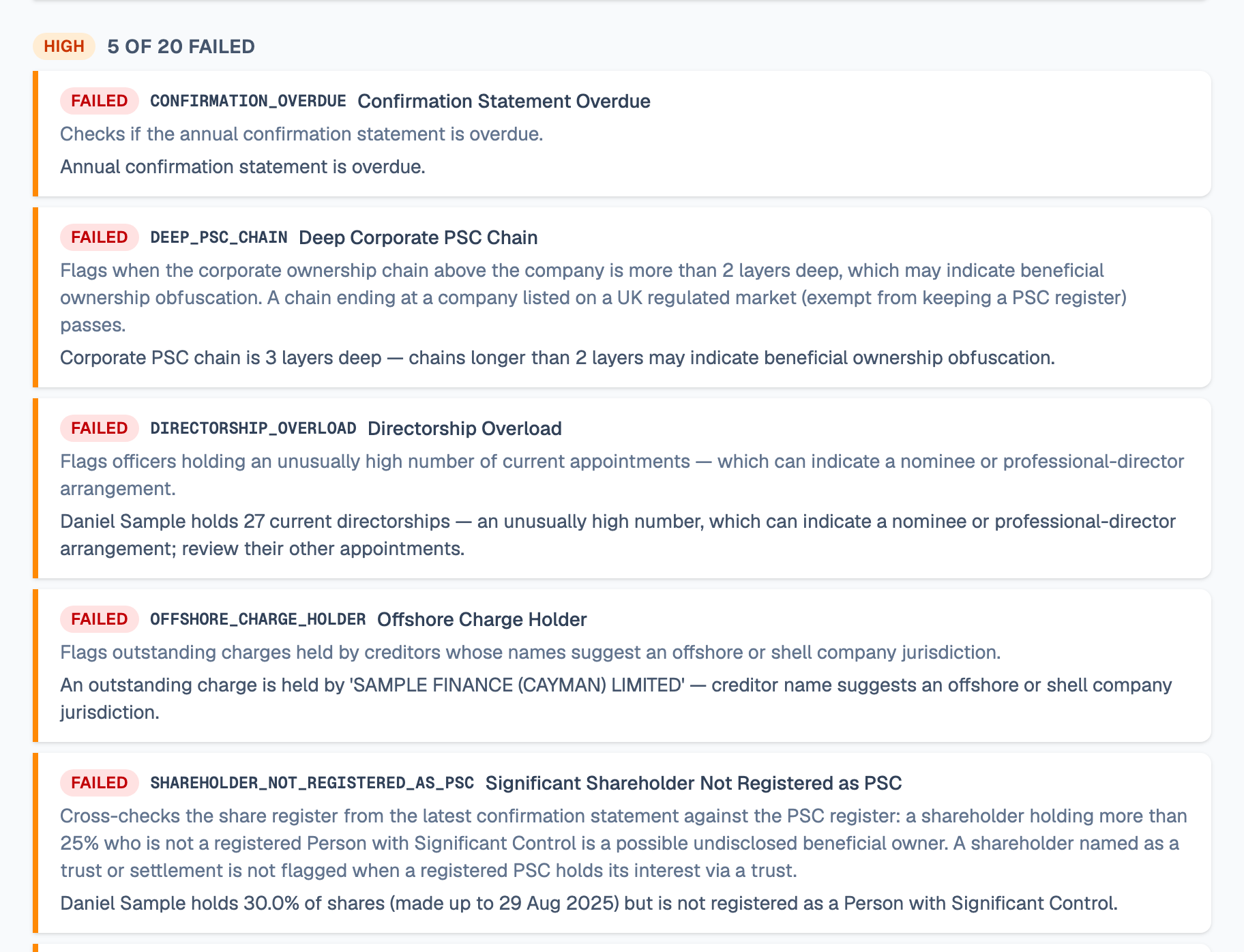
The rule engine runs over everything above. The Standard KYC Check is a library of over 50 rules, curated by KYC professionals, each with a severity and a plain-English description of what triggers it. A flag tells you what it found and why that matters, so you are not left to reverse-engineer a red badge.
Rules are configurable. You can build your own rules and rulesets without writing code, because the thresholds that matter to a solicitor's firm are not the ones that matter to an accountancy practice or a lender.
Every check also has a tab where you can inspect the underlying data. A flag you cannot trace back to its source record is a flag you cannot defend in a file, so the evidence sits next to the conclusion. When the assessment is done, it can be exported as a PDF report with each source and the time it was checked recorded, ready to go into a customer due diligence file.
What it will not do (At the moment)
Some of these are scope decisions, and some are things we do not have the data to do properly. Either way, you should know them before you rely on it. But don't worry if you really need something on this list, some of these things are already on the roadmap.
- No PEP screening. Sanctions lists and politically exposed persons are different things, and we have no PEP data source.
- No ongoing monitoring. An assessment is something you run. Nothing watches a company afterwards or alerts you when it changes.
- UK companies only. GLEIF lets us follow a parent chain abroad, but that is not the same as screening a foreign company.
- No credit scores or views on financial health.
- Not live data. Most Companies House data comes from a regularly refreshed copy of the bulk register, and sanctions lists refresh on a schedule. An assessment runs in seconds; that is a claim about speed, not about how old the data is.
- The PSC register is not a definitive list of beneficial owners. It records what the company has filed. The report says that rather than presenting it as verified ownership.
Most importantly, KYC Central does not discharge anyone's AML obligations. It gathers the evidence and flags the signals; the judgement, and the responsibility for it, stay with you. We are not authorised or supervised by any regulator, and no part of the product should be read as implying otherwise.
Seeing it before it opens
There is a sample assessment of a fictional company, laid out exactly as the dashboard would show it, and a sample PDF report of the same company. Both are worth reading with a reviewer's eye: look at what they flag, and at what they say they could not check.
If you would like to know when KYC Central opens, join the waitlist. We will email you once, at launch.