
Cited or Nothing: How Our Regulatory Q&A Answers, and When It Refuses
Our regulatory Q&A answers only from named UK primary sources, cites every claim, and says plainly when its sources don't cover a question.
The KYC Central Team ·
KYC Central's regulatory Q&A answers questions about UK anti-money laundering rules from a fixed set of named primary sources, attaches a citation to every substantive claim, and when those sources do not cover the question, says so in one sentence. This post explains how an answer is put together, why we chose that bar, and what a citation still does not tell you.
What it answers from
The corpus is named, not vague. It includes the Money Laundering Regulations 2017 with their 2019 and 2022 amendments, Part 7 of the Proceeds of Crime Act 2002, Part III of the Terrorism Act 2000, the Criminal Finances Act 2017, and the Economic Crime and Corporate Transparency Act 2023. On the guidance side it holds JMLSG Guidance Parts I to III, the FCA's SYSC sourcebook and Financial Crime Guide, OFSI's general guidance on financial sanctions, HM Treasury's advisory notice on high-risk third countries, HMRC's guidance for the businesses it supervises, and the 2025 National Risk Assessment.
That list is the whole point. If you know which documents an answer could have come from, you know what kind of answer to expect, and you know where its knowledge stops.
How an answer is put together
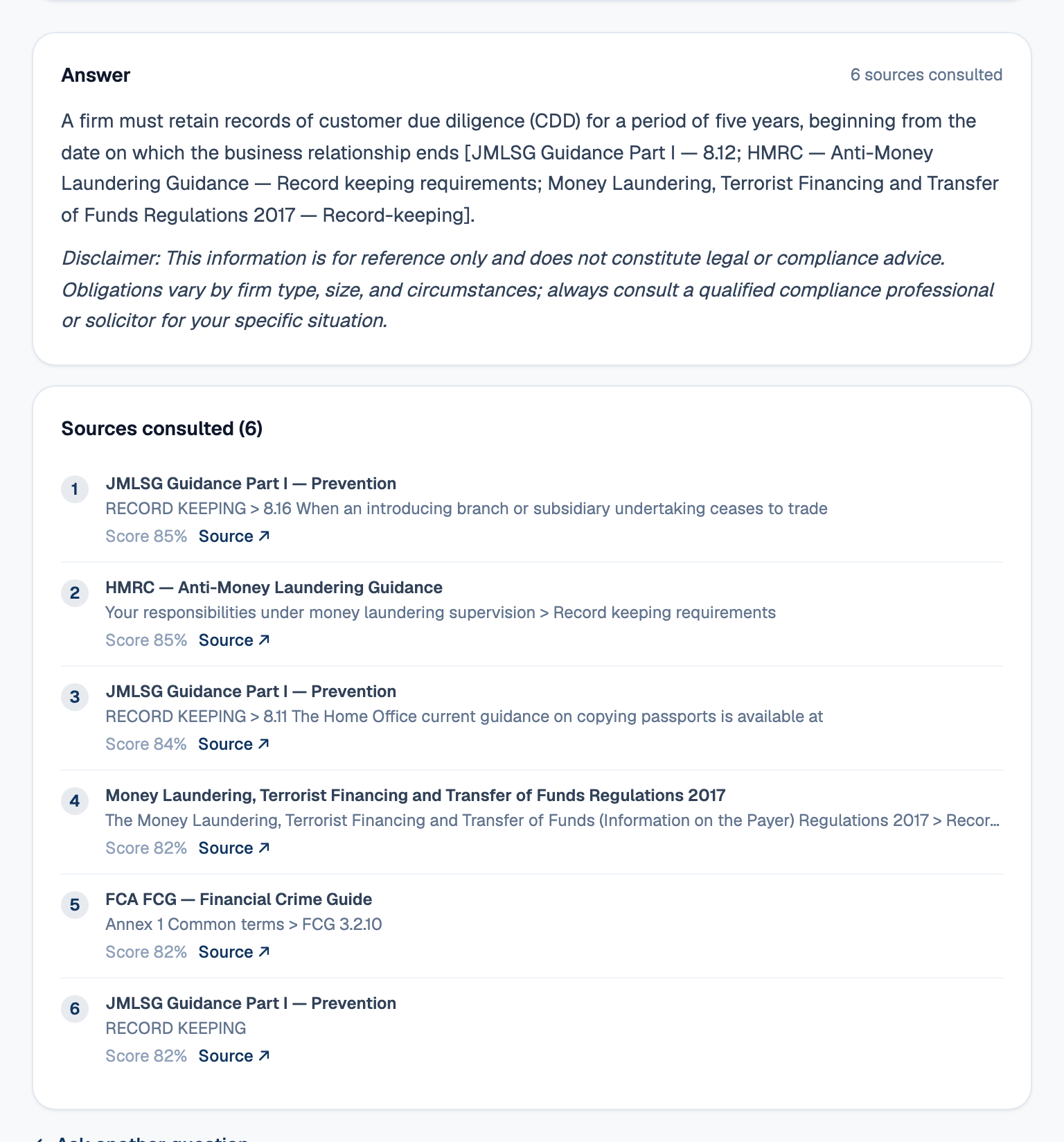
When you ask a question, the system first searches the corpus for the passages closest in meaning to it. Passages that are only loosely related are discarded, and at most six distinct passages go forward, each labelled with its document title and the heading it sits under.
The model is then given those passages and a short set of rules. It must answer only from the passages in front of it, not from its own recollection of the law. After each substantive regulatory claim it must add an inline citation in the form [document title — heading]. It must keep what a provision requires or prohibits separate from general context. Below the answer, the page lists every source consulted, with a link to the original.
The aim is that every sentence you might rely on can be traced to a passage you can open and read yourself.
The one-sentence answer
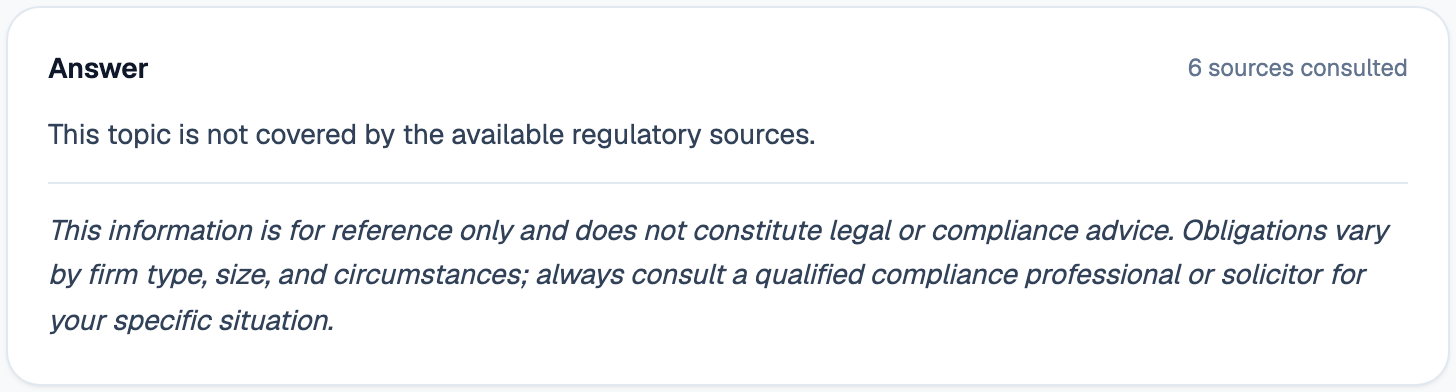
If the search finds nothing relevant, the model is not asked at all. The answer is fixed: "This topic is not covered by the available regulatory sources." The same sentence is what the model is told to give when the passages it was handed do not cover the question.
It is a deliberately unhelpful-looking output. An assistant that always returns a confident paragraph is indistinguishable from one that is guessing, and in compliance work you cannot tell which one you got until it matters. We would rather show you a plain "not covered" than a plausible paragraph with nothing behind it.
What a citation does not tell you
Being clear about the edges is part of the job.
A citation shows where a sentence came from. It does not show that the passage has been read correctly. A model can paraphrase a provision badly, or attach a citation to a passage that only partly supports the sentence beside it, which is why the source link is there and why it is worth opening for anything that goes into a file.
The search can also miss. Matching by meaning is good, not perfect, and a relevant provision phrased very differently from your question may not come back. The corpus is a selection of UK primary sources and official guidance, not every document a regulator has ever published, and sector guidance outside it will not appear in an answer.
It will not tell you how a provision applies to a named client or a specific transaction. Obligations vary by firm type, size and circumstance, and applying a provision to a real situation is a compliance professional's judgement, not a retrieval system's. The answer says so itself.
And it is not legal advice. KYC Central is not authorised or supervised by any regulator, and an answer from the Q&A is a starting point for your own reading, not a substitute for it.
Seeing it
The regulatory Q&A opens with the rest of KYC Central. Until then, there is a sample assessment of a fictional company on the site, and if you would like to know when we open, join the waitlist. We will email you once, at launch.